
Program
Featuring
“Nulli secundus,” said the famous Dutch philosopher and theologian Desiderius Erasmus of the Franco-Flemish composer Jacob Obrecht, thereby describing him as one of the greatest composers of his time, “without equal.”
With this program, Cappella Pratensis presents its Gramophone Award-winning performance of Jacob Obrecht’s Missa Maria zart. This work, which musicologist Rob Wegman describes as “The Sphinx,” is unique in the repertoire – one of the true masterpieces of Franco-Flemish polyphony.
With a duration of nearly an hour, the piece ranks among the most monumental works of Renaissance polyphony. The popular German sacred song “Maria zart, du Edler Art,” which appears as the cantus firmus in the tenor part, is embellished with endlessly inventive sequences and patterns. It was perhaps these examples that prompted the humanist Paolo Cortese to write in 1510 that Obrecht “has sown more masterful sweetness into the music, with skillful harmony, than was necessary to delight the ear.”
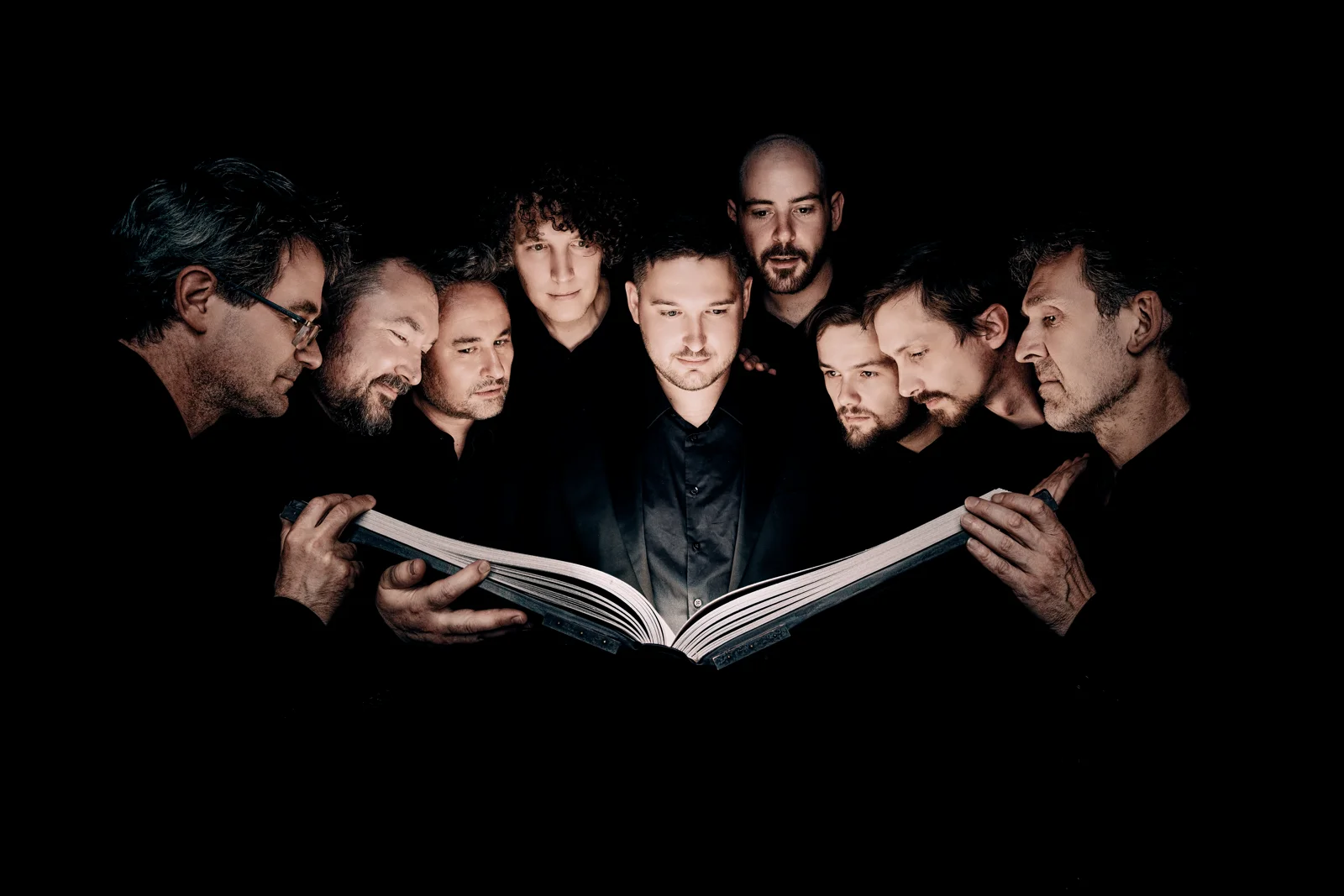
Eight singers from Cappella Pratensis bring the sounds and imagery of Renaissance music to life, gathered together around a single choir book, creating an intense and intimate soundscape. The manuscript, which reproduces the dense and complex mensural notation of that era, was specially created for the ensemble by Marc Busnel, master calligrapher and singer with the ensemble.
Inspired by historical performance practices, the singers convey nuances of rhythm and phrasing through various gestures and physical contact, as the notation – unlike a modern choral score – requires the performers to make real-time decisions regarding aspects such as text placement and unnotated articulations. The result is a creative and flexible interpretive approach deeply rooted in historical practice.